
Aurral
Open-source self-hosted music discovery and playlist companion for Lidarr with personalised recommendations, playlist automation, and multi-user support.

What is Aurral?
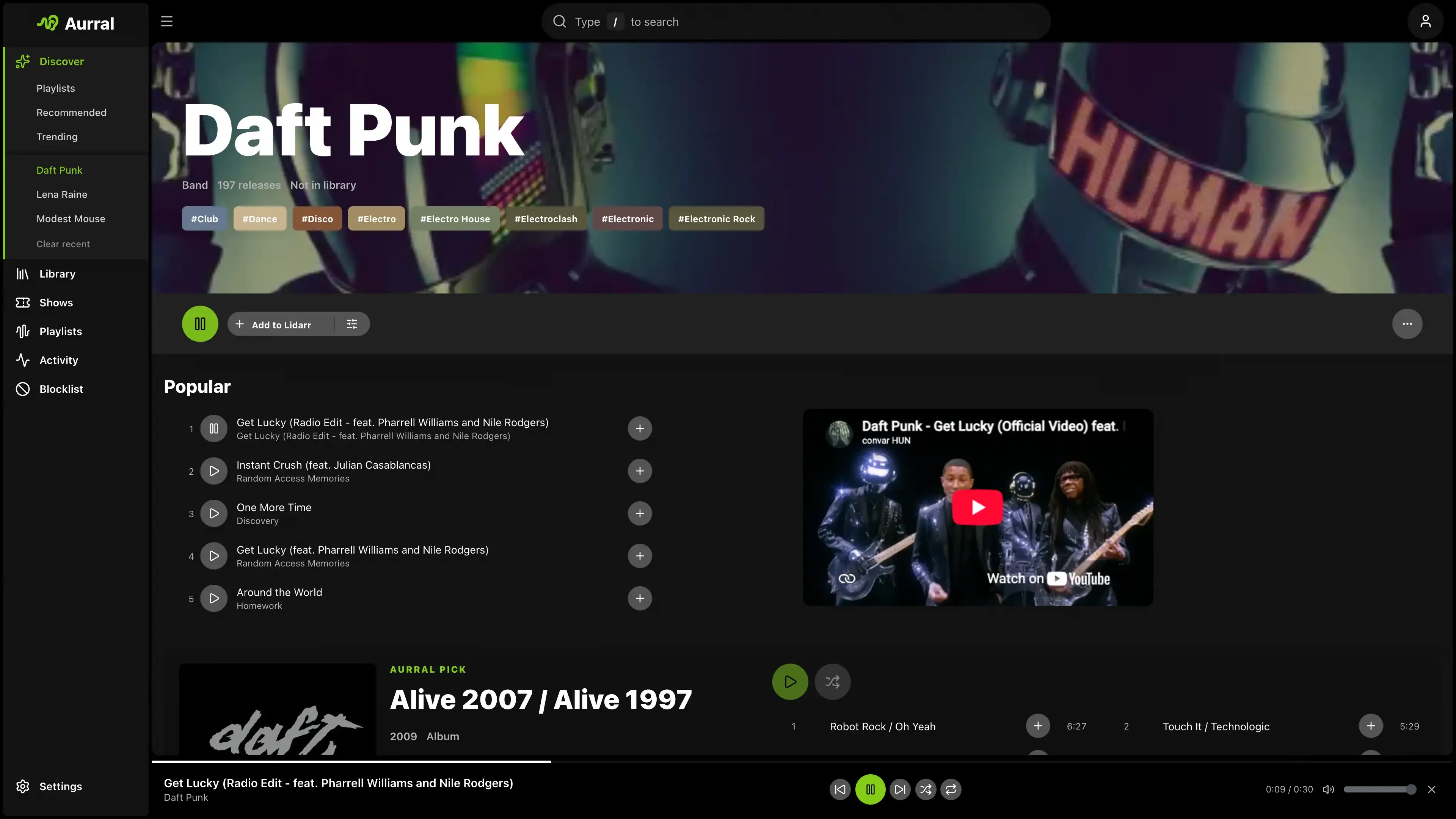
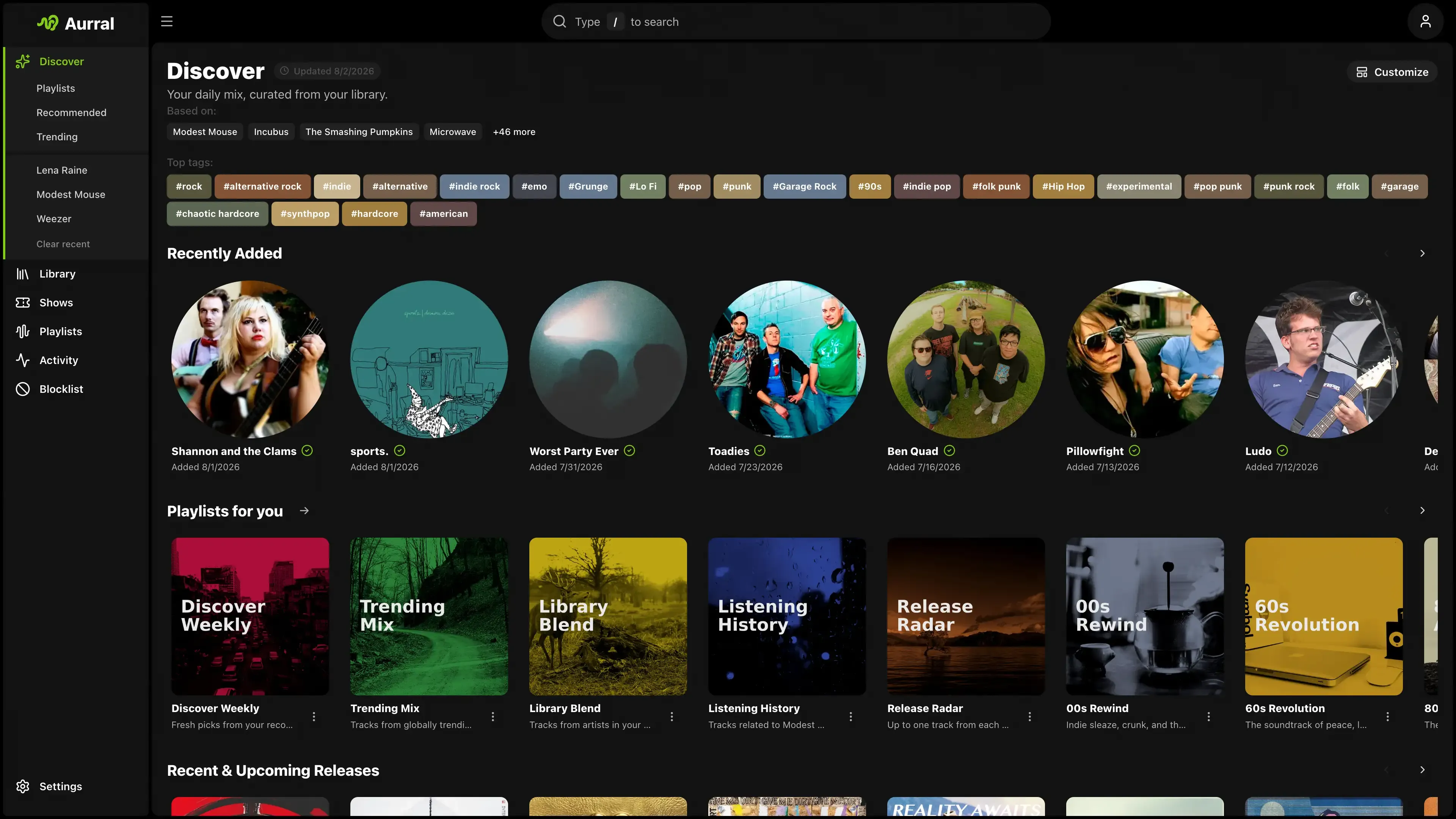
Aurral is a self-hosted music discovery and playlist automation app built as a companion to Lidarr. It sits on top of your existing music library and adds the missing discovery layer that Lidarr itself does not provide: personalised recommendations, trends, tag- and similarity-based exploration, scheduled playlist flows, and a Spotify/Last.fm/ListenBrainz-style listening experience you fully own.
Unlike Spotify, Aurral does not lock your catalogue behind a subscription, send your listening history to a third party, or restrict features to a paid tier. Everything runs in Docker on your own hardware, and playback is handled by a music server you already control (Navidrome, Plex, or Plexamp).
Key features
- Discover: personalised recommendations, trending artists, tag-based exploration, recent releases, rotating discover playlists, and nearby shows (Ticketmaster integration).
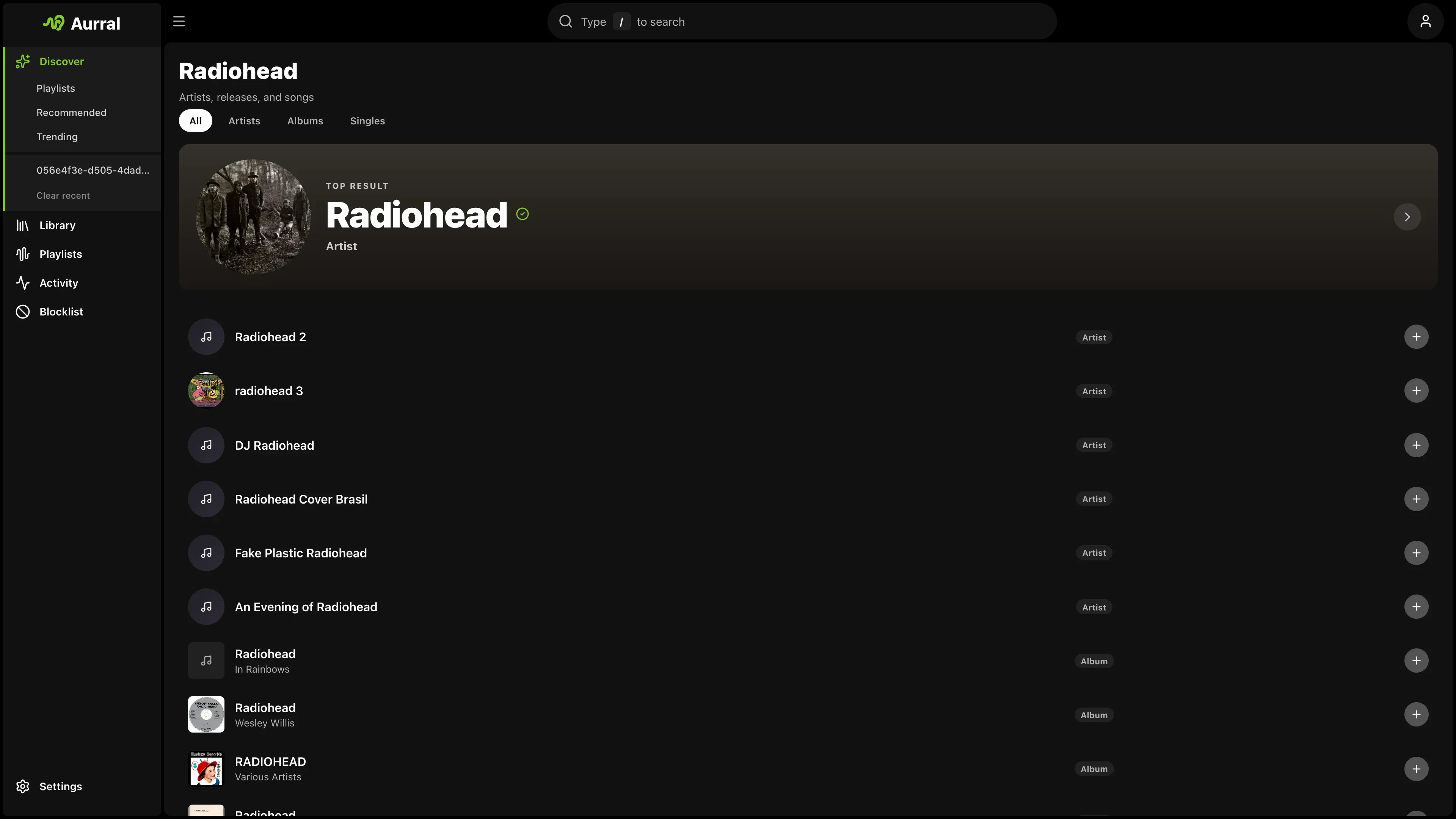
- Search: search artists and albums, preview tracks, and add the result to Lidarr with your existing quality and folder defaults.
- Library: browse and search the artists already in Lidarr without leaving the web UI.
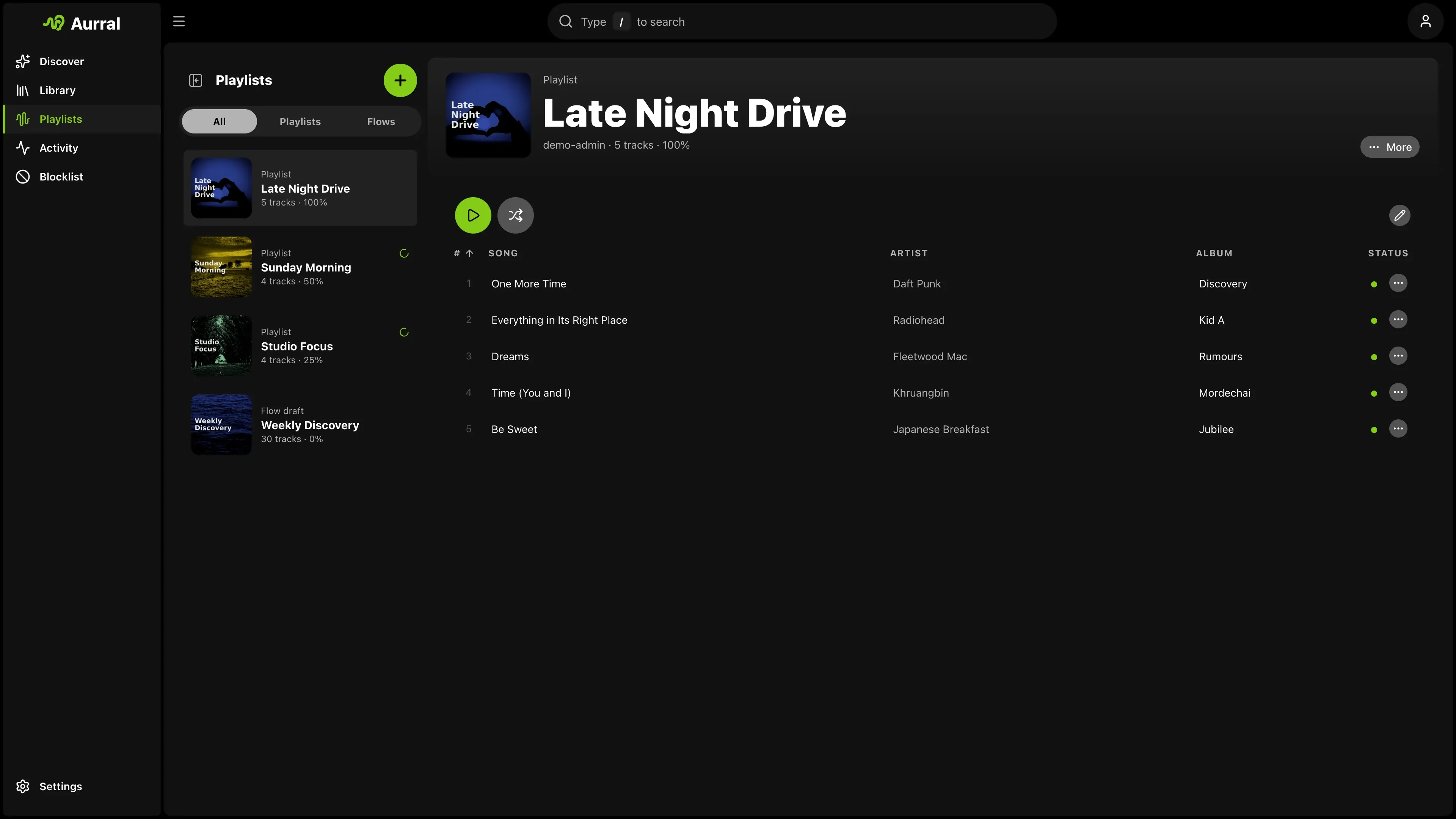
- Playlists: scheduled flows that act like Spotify Release Radar, plus imports from Spotify, Last.fm, and ListenBrainz. Convert any flow into a fixed tracklist.
- Activity: a unified queue and history for Lidarr requests, yt-dlp / slskd / Usenet downloads, plus Wanted actions for Aurral playlist jobs.
- Integrations: Lidarr, Last.fm, ListenBrainz, Koito, yt-dlp, slskd, SABnzbd/NZBGet, Navidrome, Plex, Ticketmaster, Gotify, and webhooks.
- Multi-user: per-user profiles, per-user discovery layout, permissions, local auth, LAN auto-login, reverse-proxy SSO, and native OIDC.
Self-hosting
Aurral is distributed as a single Docker image (ghcr.io/lklynet/aurral). A docker-compose.example.yml in the repository shows a full stack with Lidarr, slskd, and Navidrome. The web UI runs on port 3001 by default and stores configuration under /config.
How it compares to Spotify and Last.fm
- vs Spotify: Spotify is a streaming service that owns the catalogue. Aurral works against music you already own, integrates with Lidarr to fill gaps automatically, and gives you the same kinds of discovery surfaces (Release Radar clones, personalised mixes, playlist flows) without ads, premium tiers, or DRM.
- vs Last.fm: Last.fm focuses on scrobbling and community-driven recommendations. Aurral covers scrobbling through its Last.fm integration but goes further by turning those signals into scheduled playlist flows and Lidarr-aware requests that automatically download new releases.
Categories:
Build with:




Frequently Asked Questions
Which platforms does Aurral run on?
Aurral ships as a single Docker image that runs anywhere Docker does, including Linux servers, Synology and Unraid NAS devices, and macOS or Windows hosts for testing. There is a web UI on port 3001 and no separate mobile or desktop app — playback is delegated to Navidrome or Plex/Plexamp.
What authentication options does Aurral support?
Aurral supports local accounts, LAN auto-login for trusted networks, reverse-proxy SSO, and native OIDC for single sign-on with providers such as Authentik, Auth0, or Keycloak. Each user can have their own profile, discovery layout, and permissions.
Can I import existing data into Aurral?
Yes. Aurral imports playlists from Spotify, Last.fm, and ListenBrainz, and pulls listening history from Last.fm, ListenBrainz, and Koito. Existing Lidarr libraries are read directly, so your artists and albums appear in the Aurral library view automatically.
Does Aurral have an API, webhooks, or CLI?
Aurral exposes a web API used by its own frontend and supports outgoing webhooks for events such as playlist job completions. Notification targets include Gotify. There is no separate CLI.
What integrations does Aurral support?
Native integrations include Lidarr (the core library manager), Last.fm, ListenBrainz, Koito, yt-dlp, slskd, SABnzbd, NZBGet, Navidrome, Plex, Ticketmaster, Gotify, and outgoing webhooks. Playback is routed through Navidrome or Plex/Plexamp via API-synced playlists.
Does Aurral work offline or have native apps?
Aurral itself runs on your server, so once it is up it works on your LAN without any cloud dependency. It does not ship native mobile or desktop apps; mobile playback is handled through a Subsonic-compatible client pointed at Navidrome or Plexamp.
Does Aurral support collaboration or multi-user?
Yes. Aurral is multi-user out of the box, with per-user profiles, individual discovery layouts, granular permissions, and shared library browsing. Admins can create users locally or delegate authentication to OIDC.
OpenAltFinder Score
Project Details
Repository details
Updated 10/4/2026, 5:00:14 PM
View RepositoryRepository activity
Sponsor Aurral
Compare Aurral with
Similar open source alternatives

Noctis
Cross-platform lossless music player with rich library management, synced lyrics, and gapless playback for Windows, macOS, and Linux.
 Spotify
PinePods
A self-hosted, cross-platform podcast management system with a modern Rust and Python stack.
 Apple Podcasts
Sunoh
Android music app that plays YouTube Music, Gaana and Saavn plus your local files through one ad-free interface.
Spotify
Yuzic
A free, open-source cross-platform music player for Navidrome, Jellyfin, Plex and other Subsonic-compatible servers.
Spotify
Meelo
Self-hosted music server focused on metadata integration and UI, with music videos as first-class citizens and mobile apps for Android and iOS.
Spotify
MinusPod
Self-hosted podcast server that uses AI to automatically remove ads from episodes before you hit play.
Apple Podcasts