
Vinix
A Unix-like operating system written in V, booting on x86-64 and arm64 with a desktop, a package manager and Linux app compatibility.


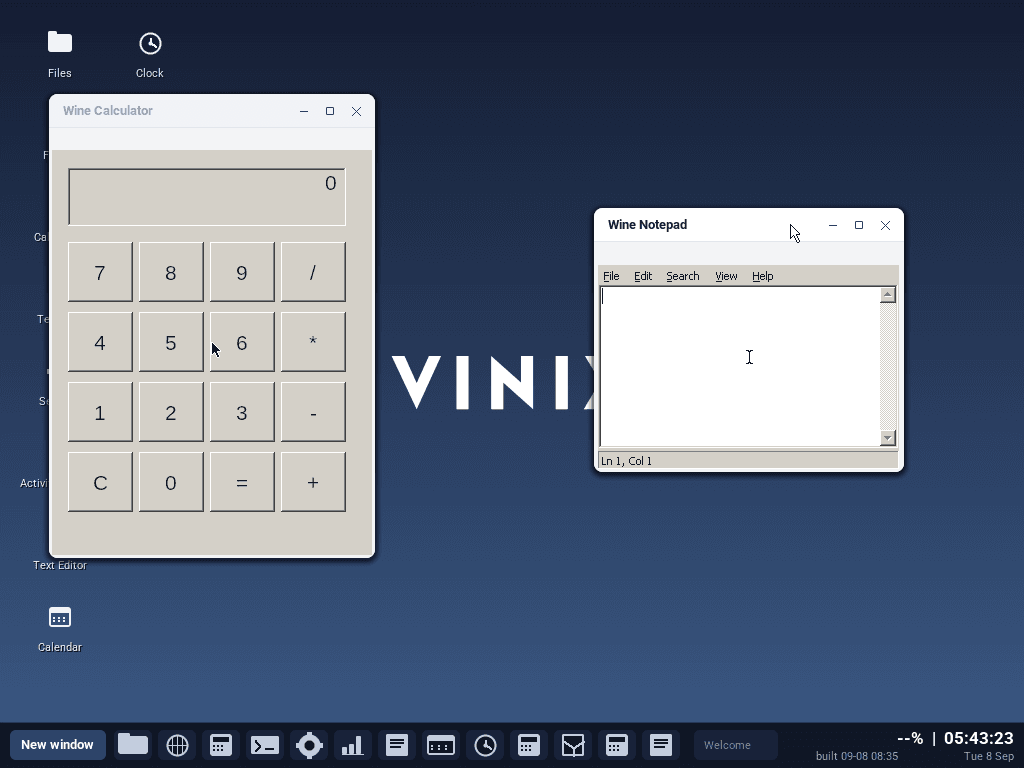
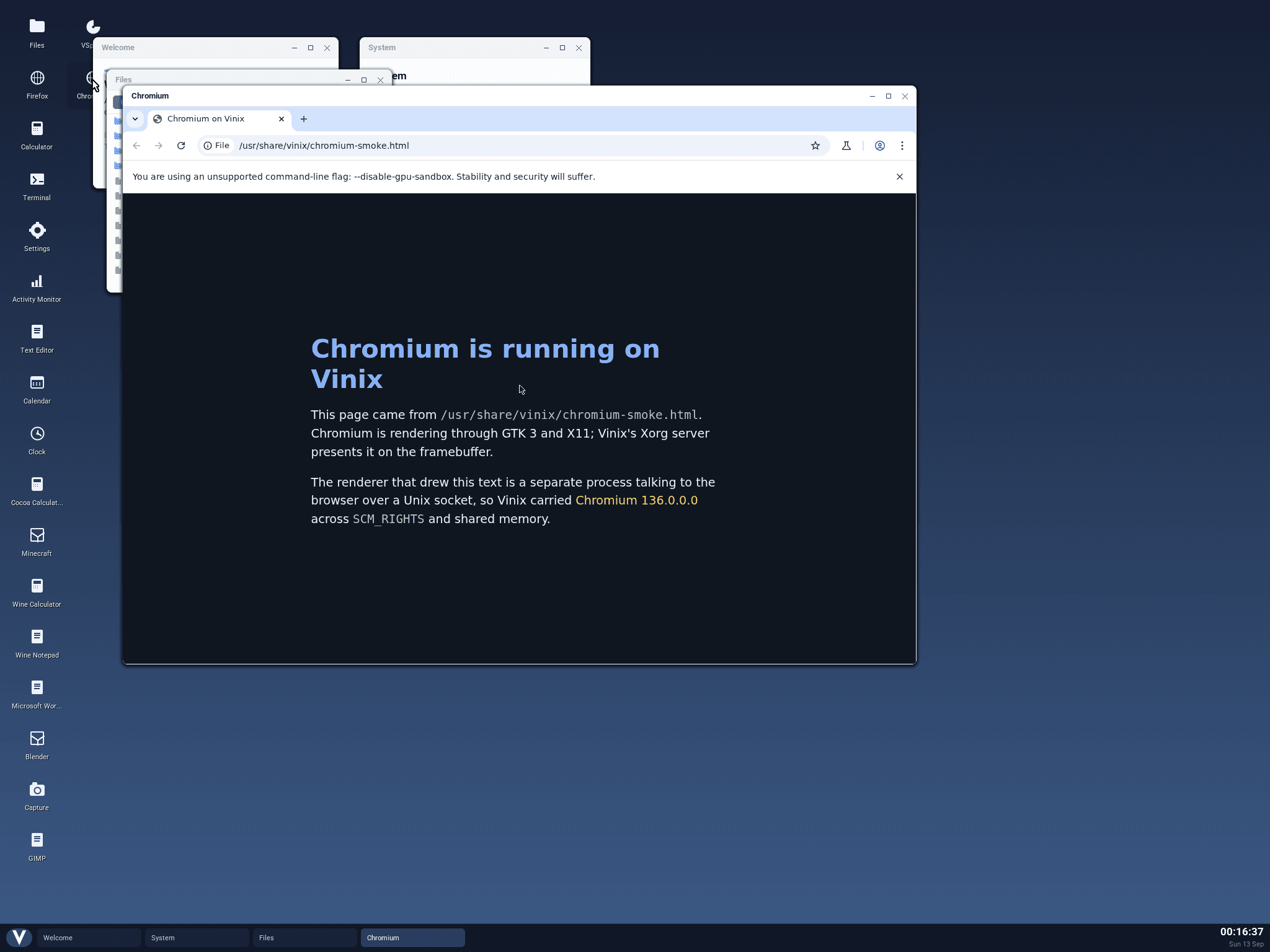
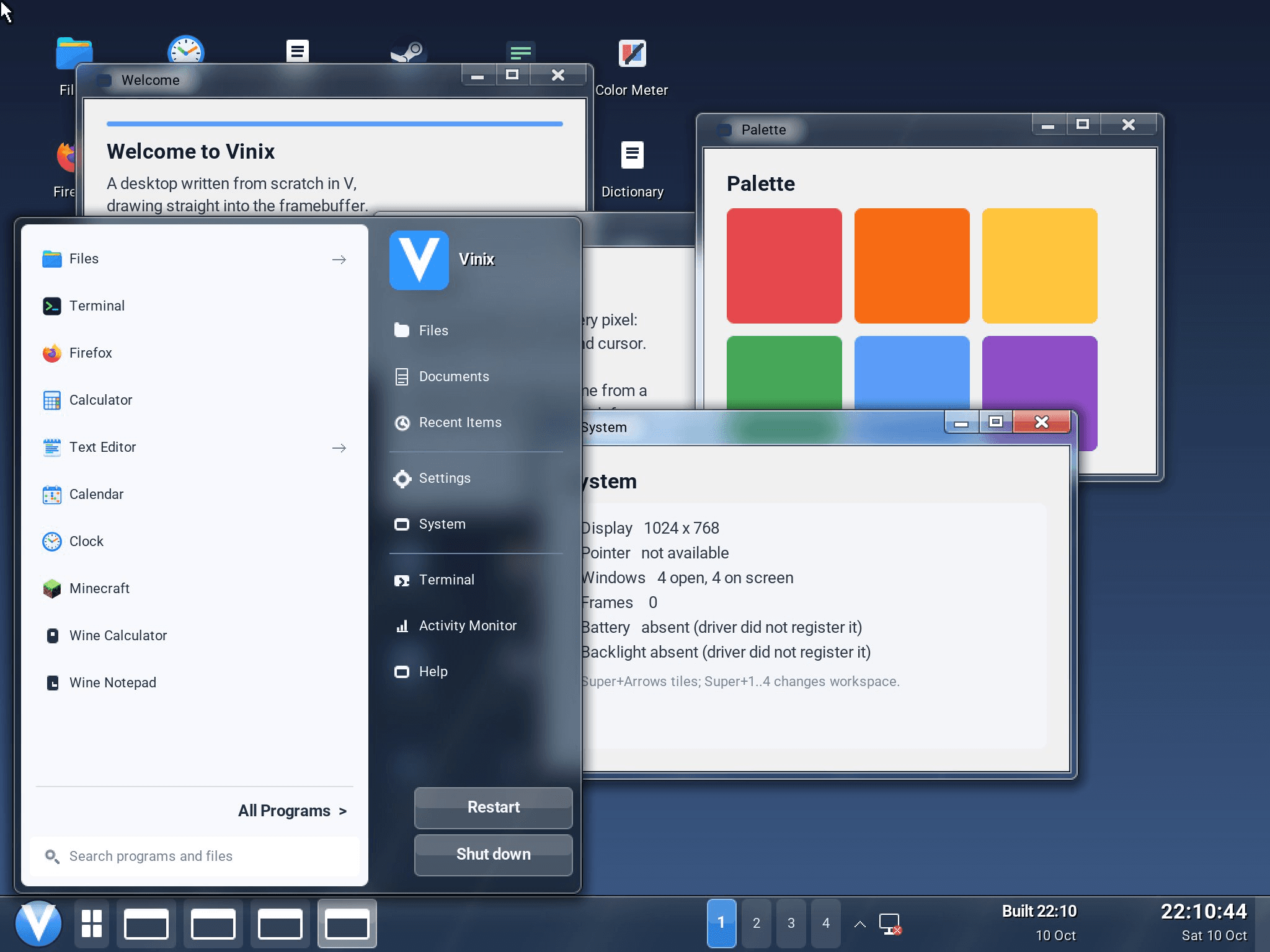
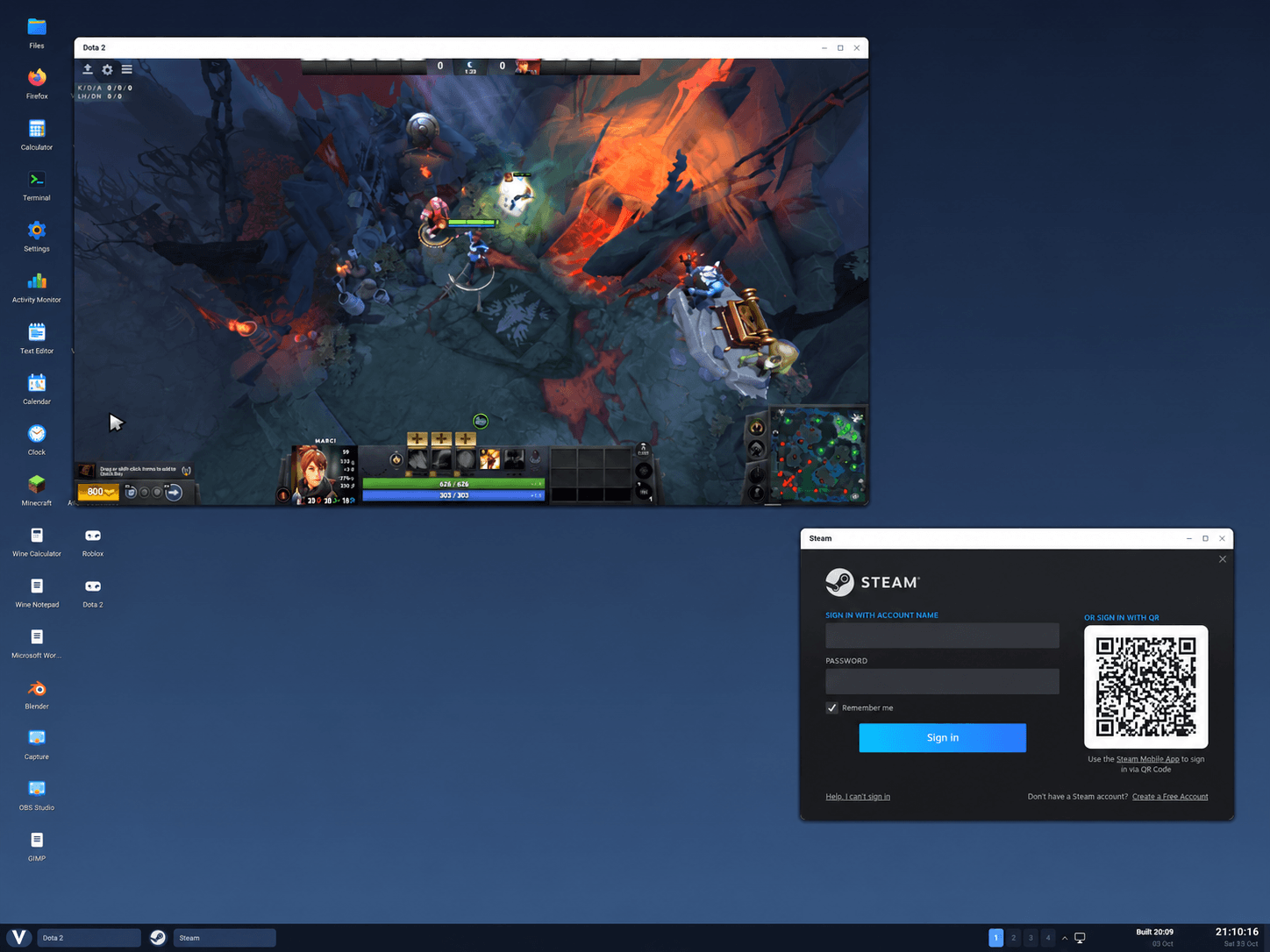
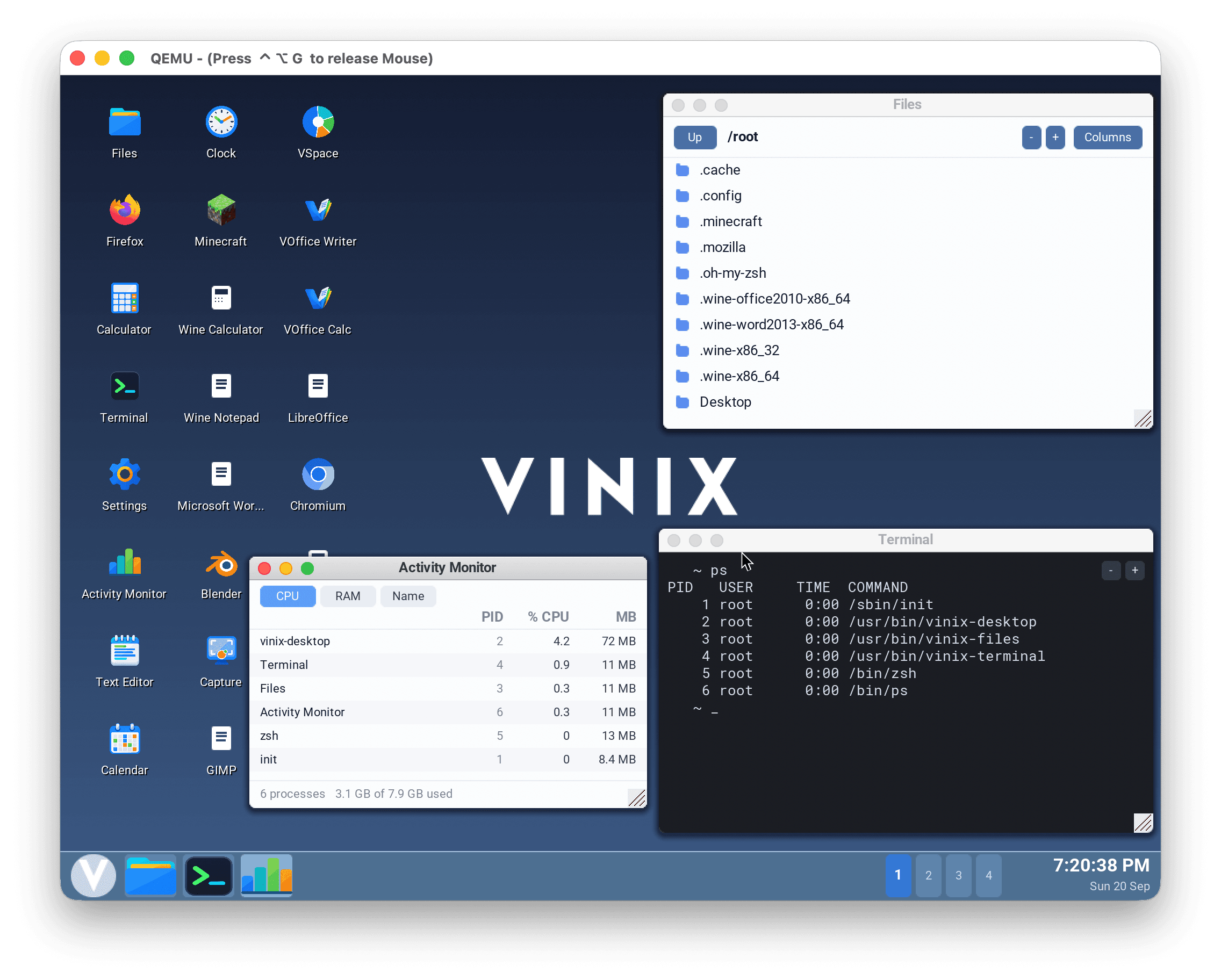
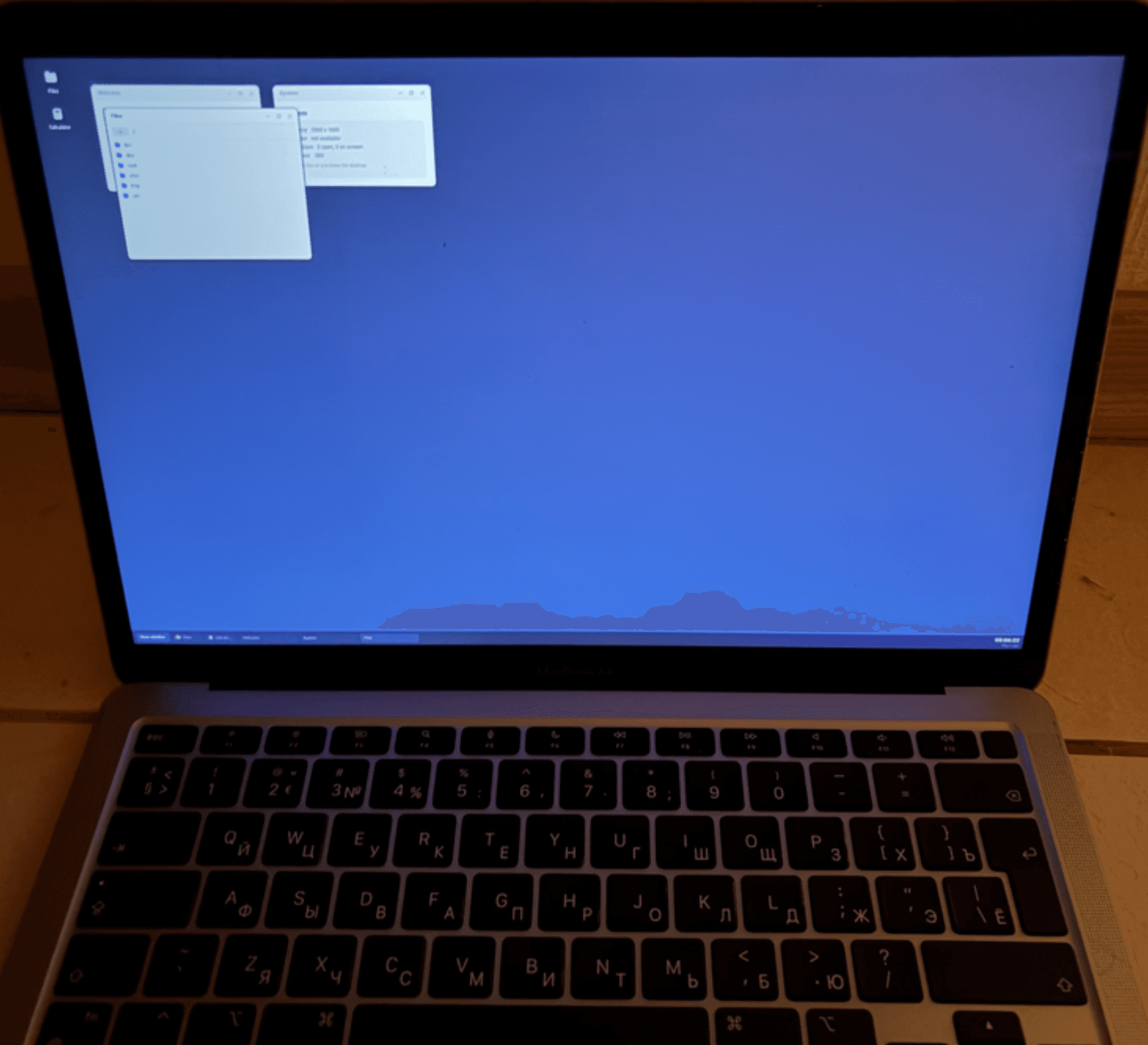
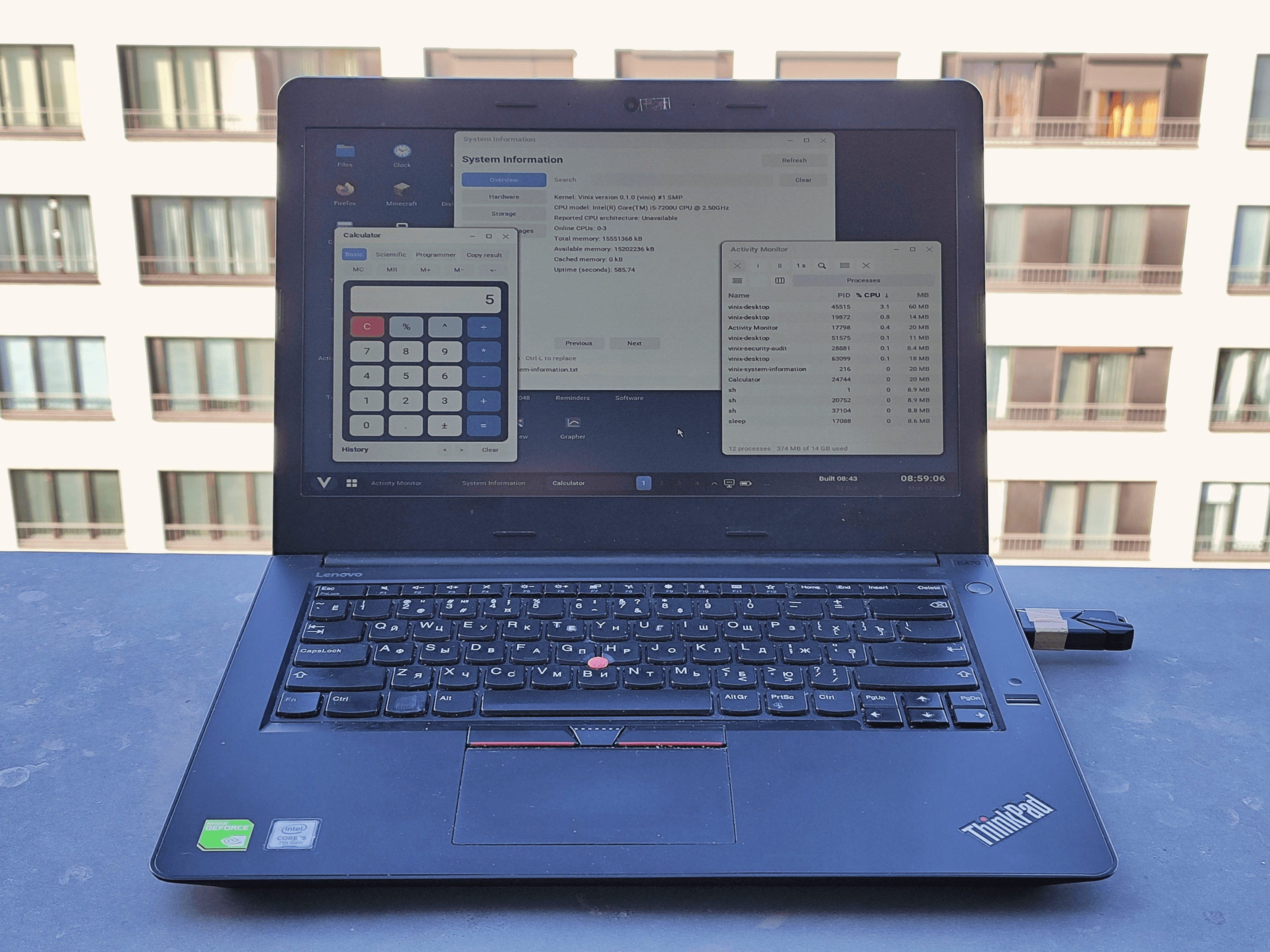
Vinix is an operating system written mostly in the V programming language, with assembly and C for the low-level parts. It aims to be a modern, fast and easy-to-read kernel that runs on real hardware rather than only inside emulators: x86-64 machines (BIOS or UEFI, IDE and SATA disks, Intel e1000 and VirtIO network cards) and arm64 machines (UEFI, VirtIO storage and networking, including Apple Silicon M1 MacBooks). It is pre-alpha software and its own README says it is not meant for daily or production use.
Despite the early stage, the feature list is broad: a monolithic kernel with SMP support, ext2 as its filesystem, its own pkg package manager backed by a binary repository, an Alpine/musl userland on arm64, and source-level Linux compatibility so existing programs can be ported. The images ship with gcc/g++, git, curl, bash and zsh, and provide X.org plus Wayland (Hyprland on aarch64) for graphical Linux applications. Native apps are built with V's own UI toolkit, V-UI 2. Recent work added real-time scheduling classes (SCHED_FIFO, SCHED_RR, SCHED_DEADLINE), NUMA and multi-socket memory topology, and an experimental Intel VT-x hypervisor exposed through /dev/hypervisor.
Compared with Windows and macOS, Vinix is a from-scratch open source system, licensed GPL-2.0, that you can read top to bottom and rebuild yourself. The trade-off is maturity: it has no iOS or macOS application compatibility yet, its Intel HD graphics driver is still a port of the Linux driver, and the project's roadmap to 1.0 describes feature parity with macOS, Linux and Windows as the long-term goal rather than a current state. It is the tool to watch if you want to see what a kernel written in a modern language looks like, or to experiment with bare-metal V.


Frequently Asked Questions
Which architectures and hardware does Vinix support?
Vinix boots on x86-64 PCs and virtual machines through BIOS or UEFI, and on arm64 machines through UEFI, including QEMU, VirtualBox and Apple Silicon M1 MacBooks. On amd64 it drives IDE and SATA disks plus Intel e1000 and VirtIO network cards; on arm64 it uses VirtIO block and network devices. It needs at least 4 GB of RAM, and a disk of 4 GB or more if you want the system to keep users and installed apps between boots.
Can Vinix run Linux applications?
Yes, within limits. Vinix keeps source-level compatibility with Linux so programs can be ported, and on arm64 it runs Alpine binaries with a musl userland. The images include gcc, git, curl, bash and zsh, and graphical Linux apps run through X.org or, on aarch64, Wayland with Hyprland. Firefox, Chromium and other large apps are downloaded with the package manager rather than shipped on the ISO.
How do I install software on Vinix?
Vinix has its own package manager called pkg, backed by a binary repository. The first launch of the desktop offers graphical applications such as Firefox and Chromium, and packages can also be installed from a shell with commands like pkg install python3. Installed apps persist on the boot disk, and booting a newer ISO with the same disk updates the system while keeping /root, where user home directories live.
What do I need to build Vinix from source?
You need GNU make, findutils, curl, git, file, xz, rsync, xorriso, Python 3, Clang/LLVM/LLD and a current V compiler, plus QEMU if you want to run the result. The build creates the ISO image for amd64 and arm64 from the same tree. Prebuilt bootable images are published on GitHub releases for each architecture.
OpenAltFinder Score
Project Details
Repository details
Updated 10/23/2026, 8:00:47 AM
View Repository Vinix vs Asterinas