
Cloud in a Bottle
Open-source platform that turns a server you control into a personal app cloud, deploying Git repos as containerized apps on your own domain.




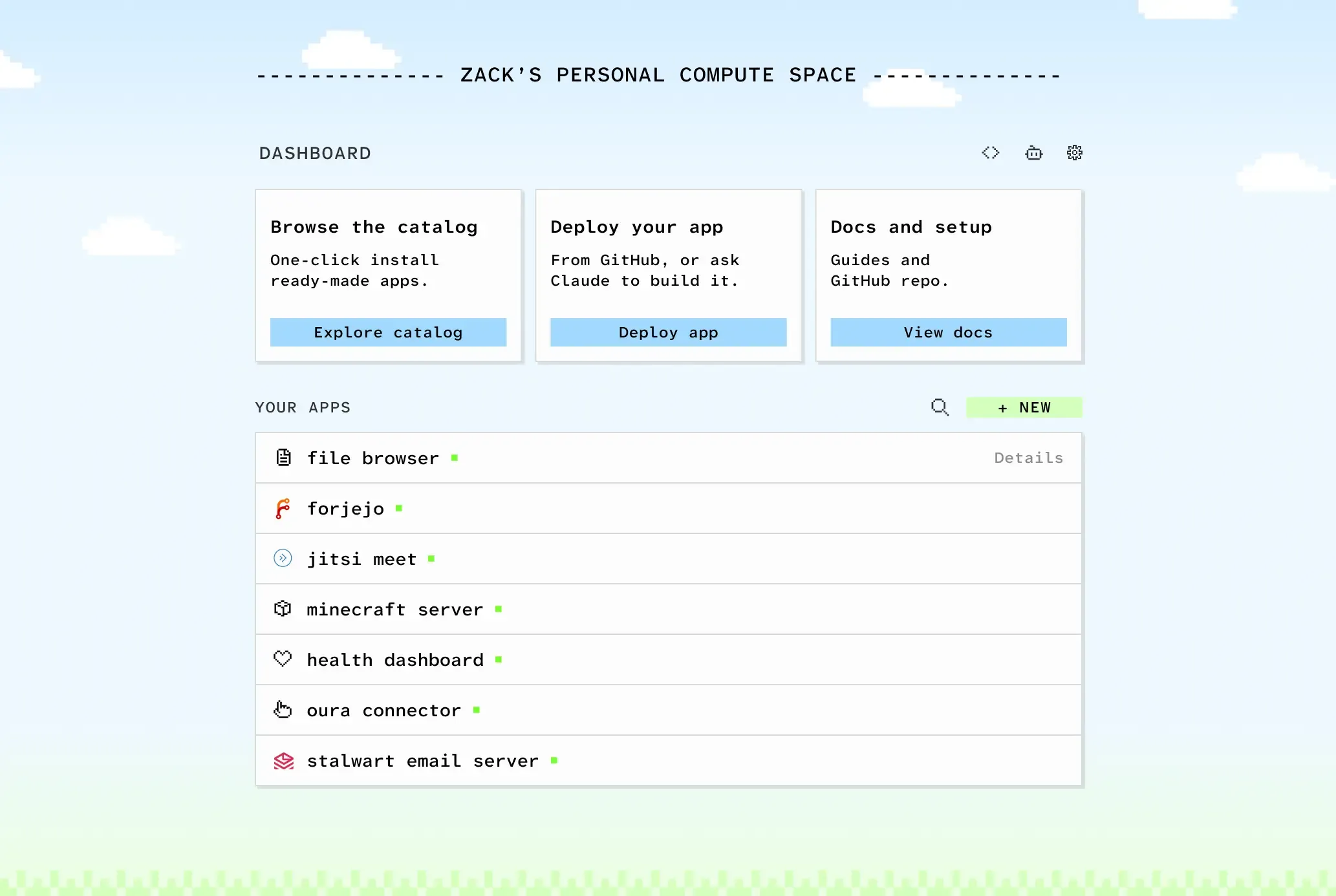
Cloud in a Bottle is an open-source personal cloud platform from Imbue that turns a server you control into a place to deploy, use, and share web apps. A web dashboard and a companion CLI install apps from Git repositories, and each app runs in a rootless Podman container on its own HTTPS subdomain. The goal is to make self-hosting feel like installing apps on a phone: open the catalog, click install, and the app is live at your own domain.
Under the hood, a Python router acts as the control plane: it reads each app's cloudinabottle.toml manifest, builds its Dockerfile with rootless Podman, and proxies HTTP and WebSocket traffic per app subdomain, with Caddy handling HTTPS and CoreDNS serving wildcard DNS. New instances ship with preinstalled apps including a catalog, an encrypted restic-based backup app, a file browser, secrets storage, an OAuth provider, and a preconfigured Matrix chat server. Apps are sandboxed by default — their own data directories, no extra Linux capabilities, and one port on loopback — and every route requires owner authentication unless the manifest explicitly declares public paths.
Compared with paid platforms like Heroku, Render, Railway, and Fly.io, the difference is who owns the infrastructure. Your apps and data stay on hardware you control, with no per-service pricing or resource quotas — everything runs on one machine, whether that is a cloud server, a dedicated home server, or a shared home machine. If you would rather not manage hardware at all, Imbue offers paid managed hosting that provisions a dedicated space for you and hands it over on your own SSH key, so you can still walk away with it.
Categories:
Build with:

Frequently Asked Questions
Which platforms does Cloud in a Bottle run on?
It targets Ubuntu Linux servers: a cloud instance with a static public IP, a dedicated home server, or a shared home machine (fresh Ubuntu 24.04 is recommended). You manage everything from a web dashboard in any browser or from the bottle CLI, and there are no native desktop or mobile apps.
Does Cloud in a Bottle have a CLI or API?
Yes. The bottle CLI covers what the dashboard does without a browser: deploying from a Git URL, checking status and logs, opening a shell inside a container, and managing several instances from one config. The dashboard also issues API tokens for scripts, and includes a browser-based terminal on the instance itself.
How do I deploy an app on Cloud in a Bottle?
Point it at any Git repository that contains a cloudinabottle.toml manifest and a Dockerfile. The router clones the repo, builds the image with rootless Podman, and serves the app at its own HTTPS subdomain. A curated catalog also offers one-click installs of known-good apps, and private GitHub repos need a one-time authorization.
How does Cloud in a Bottle handle backups?
A preinstalled backup app built on restic takes encrypted, incremental, deduplicated snapshots to storage you configure, including S3, Backblaze B2, Google Cloud Storage, Azure Blob, SFTP, rclone remotes, or a local path. You set the interval and retention rules, restore from a snapshot browser, and a migration tab can push apps and their data to another instance.
Can other people use the apps on my instance?
By default every app route requires your owner login, enforced by the router before a request ever reaches the app. An app can open specific routes to the public by declaring public_paths in its manifest. Named per-user logins are on the roadmap but are not available yet.
OpenAltFinder Score
Project Details
Repository details
Updated 10/21/2026, 7:00:46 AM
View RepositoryRepository activity
Compare Cloud in a Bottle with
Similar open source alternatives

CapRover
CapRover is a scalable self-hosted PaaS with one-click apps, Docker Swarm clustering, automatic TLS, and a friendly web UI for deploying apps and databases in seconds.
 Vercel
Dokploy
Open Source Alternative to Vercel, Netlify and Heroku.
 Netlify
Dokku
Docker-powered PaaS implementing the Heroku git-push workflow on your own server.
Vercel
Komodo
Open-source deployment and server management platform for running apps across many servers. Self-hostable alternative to Heroku, Vercel, and Railway.
 DigitalOcean
Better-PaaS
Self-hostable PaaS for deploying full-stack apps and databases with zero downtime, auto HTTPS, and Docker support.
Vercel
Coolify
An open-source, self-hostable PaaS alternative to Vercel, Heroku and Netlify — deploy apps, databases and one-click services on your own servers.
DigitalOcean