
BookStack
Open source wiki and documentation platform with a books/shelves/pages model — a simple, self-hostable alternative to Confluence and Notion.
Open source alternative to:


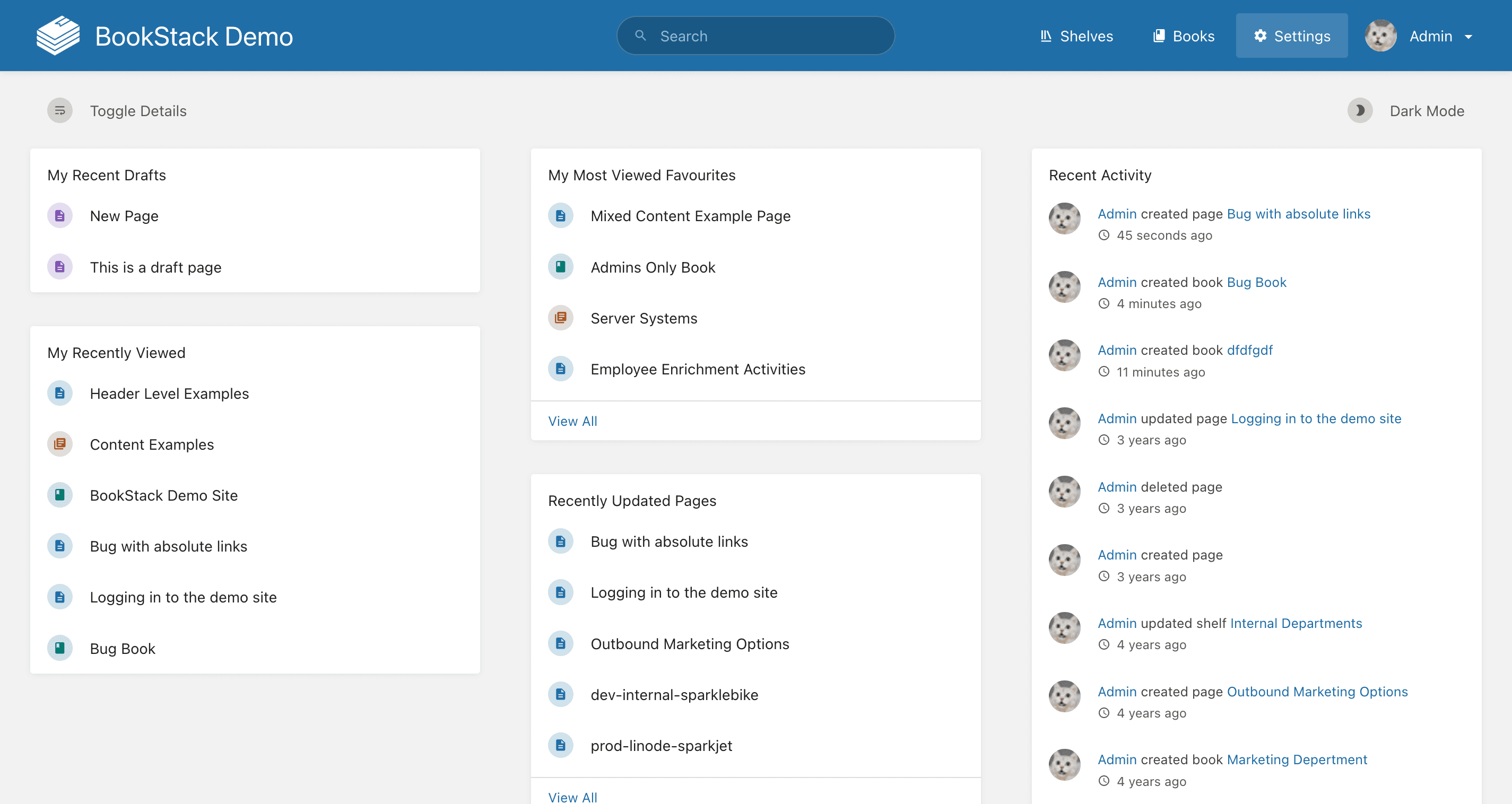
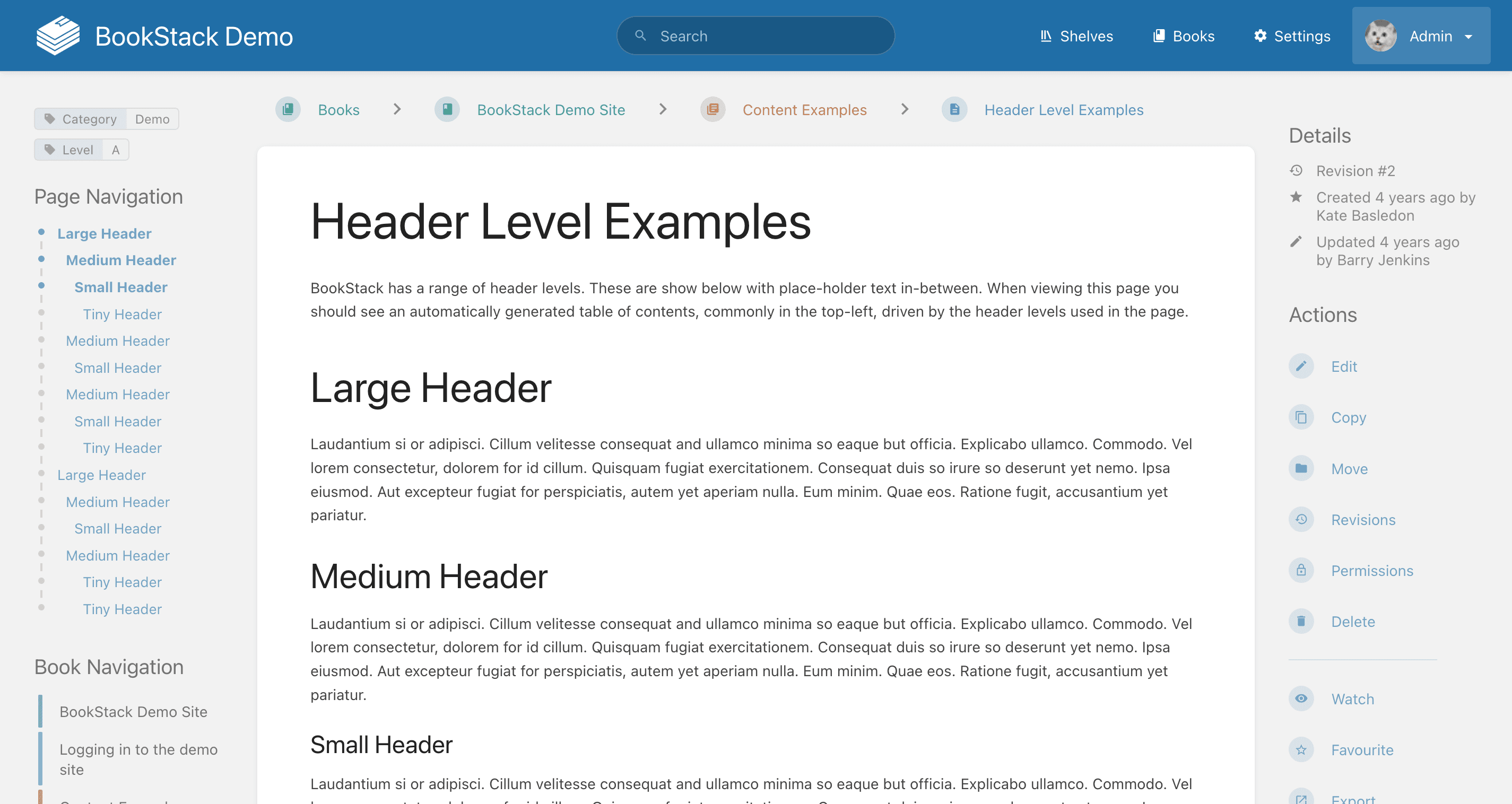
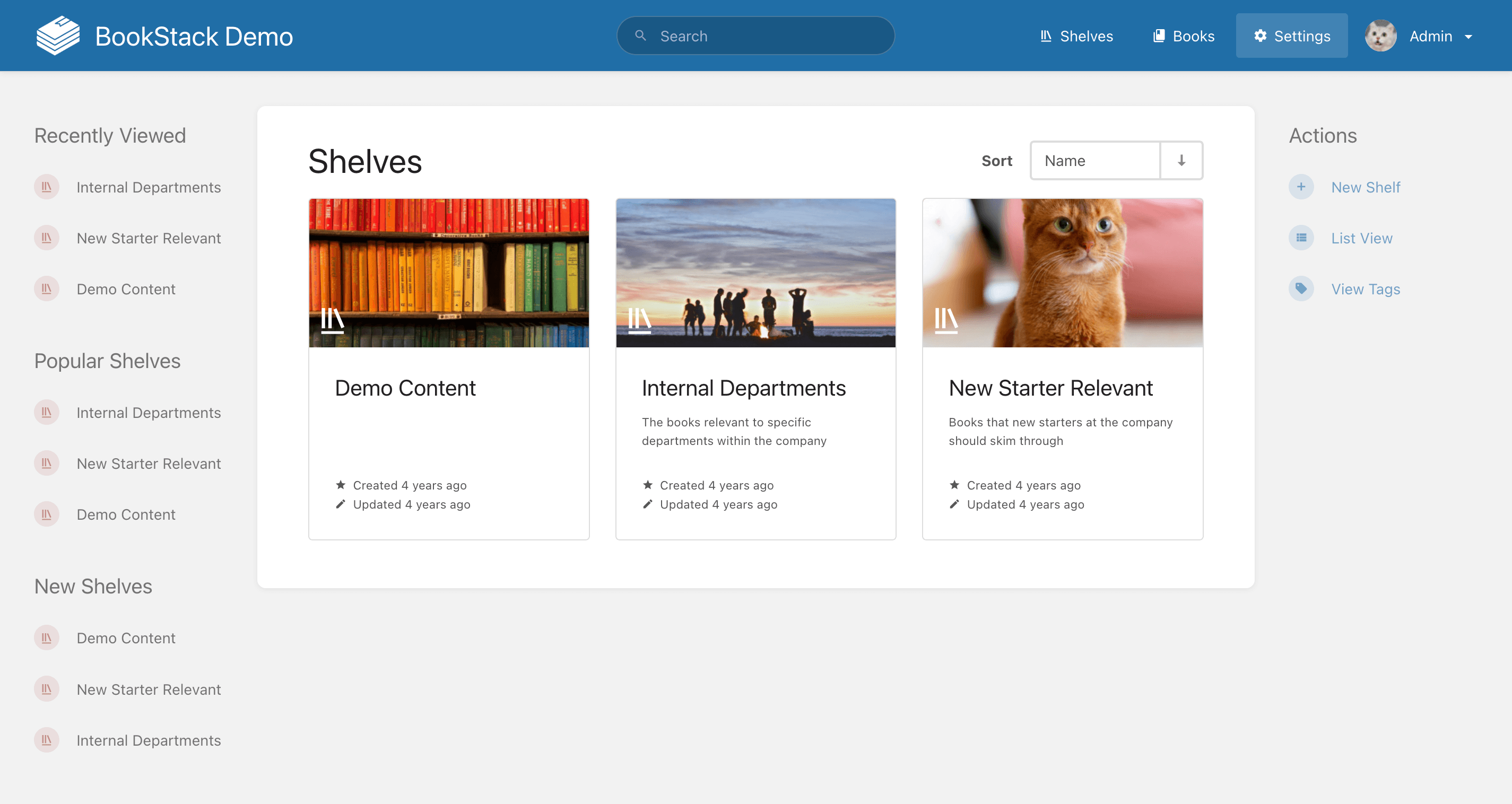
BookStack is an open source platform for creating documentation and wikis, built around an intuitive books, chapters, and pages model. It is a popular self-hostable alternative to Confluence, Notion, and Slab for teams that want a structured, easy-to-use knowledge base without a heavy subscription.
BookStack provides a WYSIWYG editor, a full-text search, image management, multi-factor authentication, role-based permissions, LDAP/OIDC SSO, and a built-in audit log. Content can be organised in a flat hierarchy (Books → Chapters → Pages) or with tags, and access can be fine-tuned at every level.
Released under MIT and built on PHP, Laravel, and MySQL, BookStack is a great fit for internal documentation, handbooks, and team wikis that need structure, simplicity, and full data ownership.
Categories:
Build with:

Frequently Asked Questions
What is BookStack and how is it different from Notion?
BookStack is a self-hosted wiki and documentation platform built on PHP and Laravel, organised around three content types: Books, Chapters, and Pages. Unlike Notion's freeform block editor, every page lives inside that hierarchy, which makes cross-page linking and navigation predictable. It ships with a WYSIWYG editor, an optional Markdown editor with live preview, and built-in diagrams.net support for inline drawings.
What do I need to self-host BookStack?
BookStack runs on PHP with a MySQL or MariaDB database and is light enough to run on a small VPS — the project cites a £2.50/month IONOS VPS as adequate. Authentication integrates with OIDC, SAML2, and LDAP for enterprise deployments, and TOTP-based multi-factor authentication can be enforced per role. The codebase is MIT-licensed and now developed primarily on Codeberg.
How does BookStack handle permissions and sharing?
BookStack uses a role-based permission system where you can lock down books, chapters, and individual actions per role, with optional TOTP MFA enforcement. Instances can be configured as fully public, restricted to logged-in users, or gated entirely behind SSO via LDAP/SAML2/OIDC. There is no real-time multi-cursor editing — collaboration is asynchronous, with every page keeping a full revision history.
Can I export my data and own it long-term?
BookStack is MIT-licensed and free to use, including for commercial deployments. Every page keeps a revision history that can be restored from the web UI, and image management is built in. Content is stored in standard MySQL and can be exported via the REST API or directly from the database, so your data is never locked into a proprietary format.
OpenAltFinder Score
Project Details
Repository details
Updated 9/21/2026, 10:00:14 AM
View RepositoryRepository activity
Compare BookStack with
Similar open source alternatives

AppFlowy
Open source Notion alternative that brings projects, wikis, and teams together with AI while keeping you in control of your data.
 Notion
HelixNotes
A fast, privacy-first local markdown note-taking app built with Tauri and SvelteKit. Your notes stay as plain .md files on your device.
 Obsidian
Jotty
Lightweight self-hosted app for managing personal file-based notes and checklists.
Notion
Outline
The fastest growing-team knowledge base — beautiful, realtime collaborative, feature packed, and markdown compatible Notion and Confluence alternative.
Notion
memos
Privacy-first, self-hosted note-taking platform with markdown support, tagging, and built-in AI — a lightweight alternative to Notion and Obsidian.
Obsidian
AFFiNE
Open-source knowledge base combining note-taking, whiteboard, and project planning in one workspace.
Notion