
Comp AI
Open-source, agentic-first CRM with a built-in research agent that books follow-ups, enriches contacts, and keeps your pipeline up to date.
Open source alternative to:


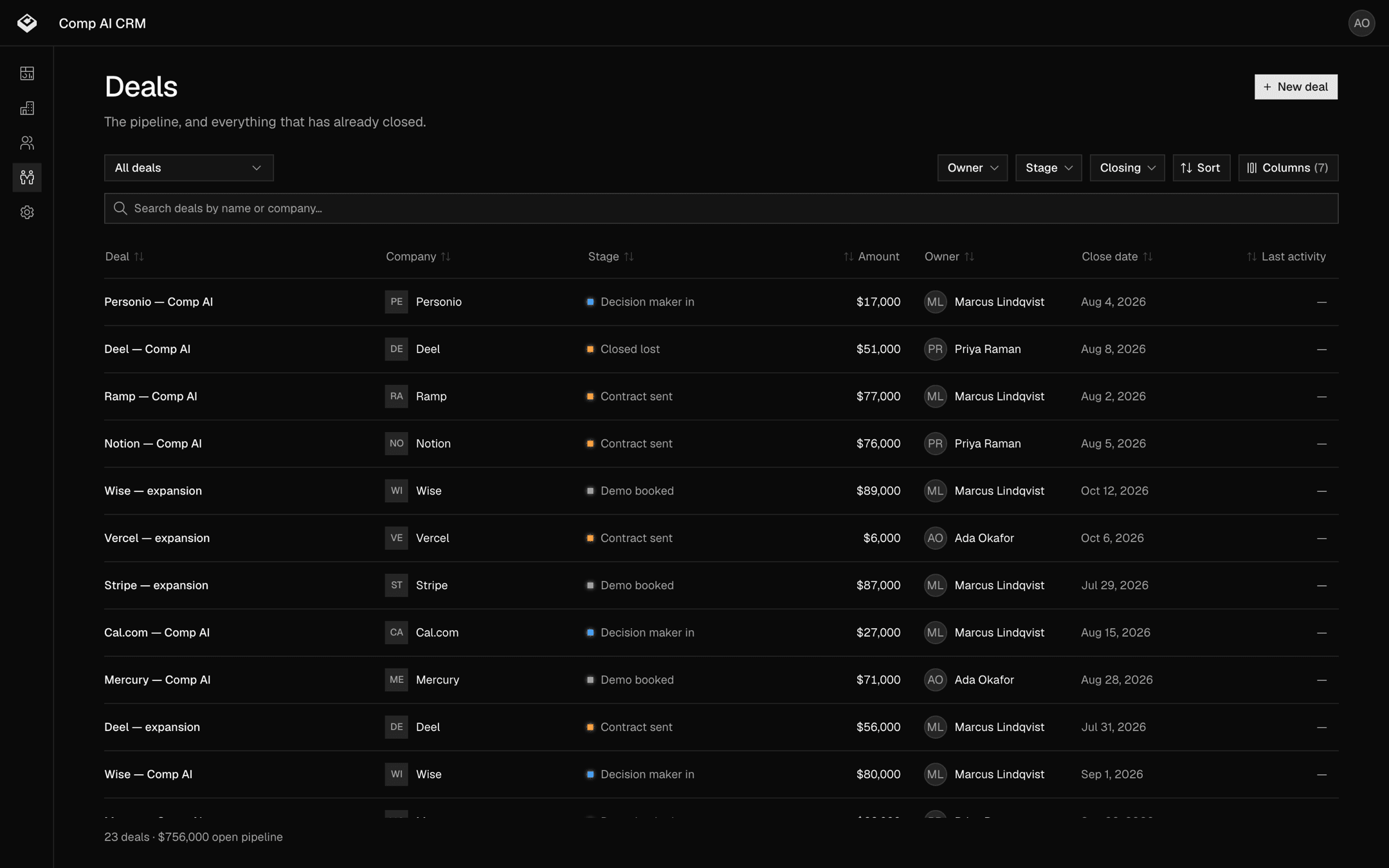
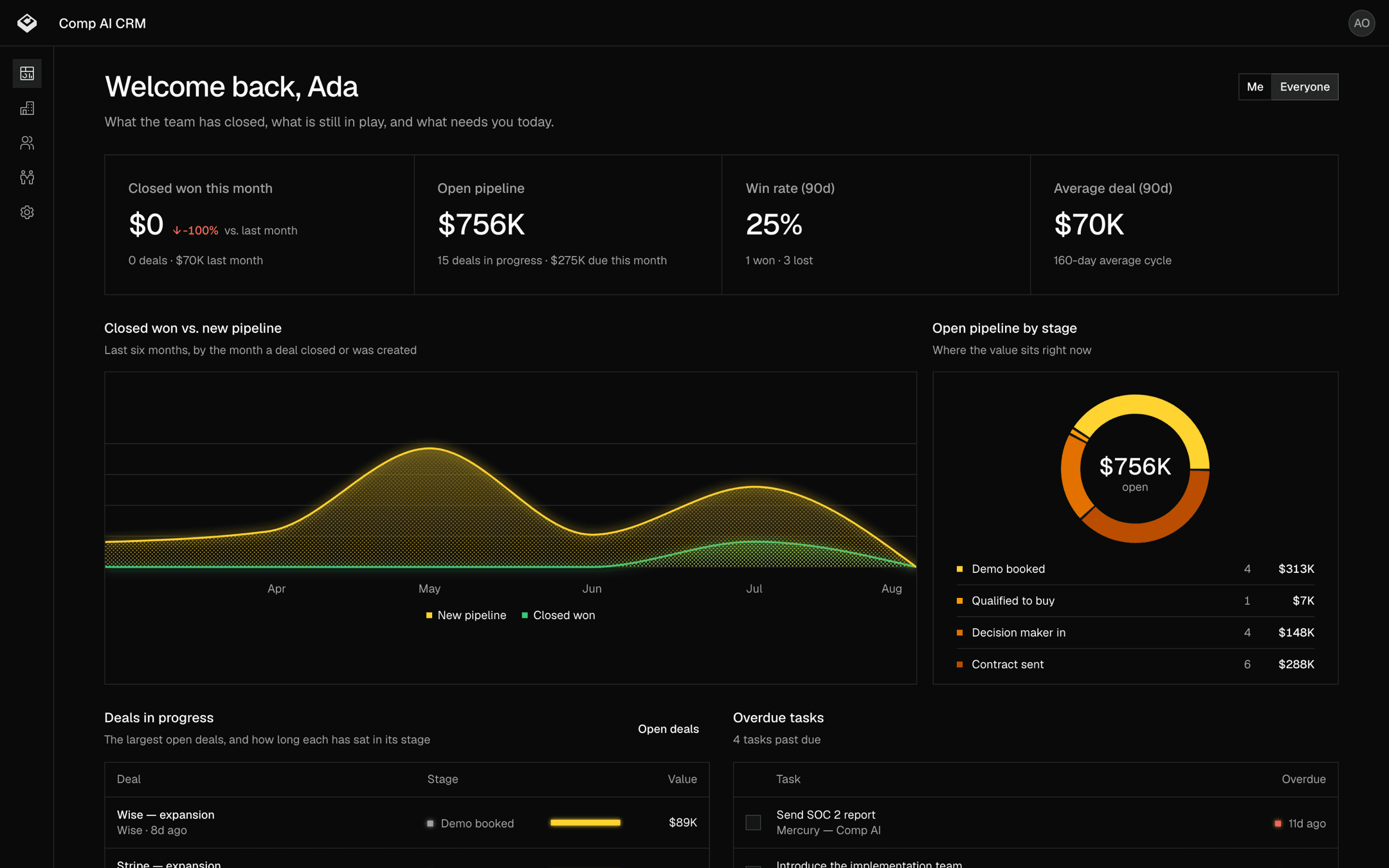
Comp AI is an open-source, agentic-first CRM built by the team behind trycomp.ai. Most CRMs are a database with a form in front of it; the AI ones bolt a chat box onto the side of that form. Comp AI is built the other way round — the agent is not a feature of the CRM, the CRM is where the agent keeps its notes. It runs on its own deployment, on its own schedule, against its own work queue, deciding what to look at next, booking its own follow-ups, and stopping when the research budget runs out.
The stack is a TypeScript Turborepo monorepo on Bun: a Next.js front end, a NestJS API with tRPC type safety, Prisma on Postgres, and a research agent built on the eve durable-agent framework. The agent ships with 18 tools (read CRM history, search, identify contact, research person, enrich company, record fact, schedule recheck) and 4 skills, runs inside a network-isolated sandbox, and is provider-agnostic via the Vercel AI Gateway.
Comp AI is single-tenant and self-hosted by design. Google sign-in is the only door; an allow-list env var is the entire authorisation model. Mailbox and calendar sync keep deals, contacts, and companies current without a human typing them in, and every outside data source (LinkedIn, web research, company brand data) is optional — the agent works with none of them. It is released under the MIT license and targets internal sales teams that want a self-hostable Salesforce / HubSpot / Pipedrive / Zoho CRM alternative without an AI feature bolted on as an afterthought.
Categories:









Frequently Asked Questions
What is Comp AI and how is it different from Salesforce or HubSpot?
Comp AI is an open-source, agentic-first CRM licensed under MIT and self-hostable. Where Salesforce and HubSpot are database-with-a-form products that bolt an AI chat onto the side, Comp AI is built around the agent first — the CRM is the database the agent writes to. The agent runs on its own schedule, decides what to look at next, books its own follow-ups, and stops when the research budget runs out, rather than waiting for a human to drive it through a UI.
What does "agentic-first" actually mean in Comp AI?
It means the API has no intelligence in it at all: the NestJS service just reports that something happened by writing a row to a queue, and the agent — running on Vercel's eve framework — leases that row and decides what it means. The agent ships with 18 tools (read_crm_history, search_crm, identify_contact, research_person, enrich_company, record_fact, schedule_recheck...) and 4 skills (evidence, identity matching, data boundaries, writing a brief) that are versioned like code. It runs inside a network-isolated sandbox with deny-all egress, and it has no DATABASE_URL, so a shell command cannot exfiltrate customer data.
Can I self-host Comp AI and what does it need?
Yes — it is single-tenant and self-hostable by design. The quickstart needs Bun and Docker; docker compose up -d brings up Postgres on :5432, then bun run db:deploy applies the Prisma migrations and bun run dev starts the app on :3000 and the API on :3001. Production deploys are three independent Vercel projects (app, API, agent) plus a Postgres, and the only shared secrets are DATABASE_URL and BETTER_AUTH_SECRET.
How does the research agent get my data into the CRM?
Most contacts and companies are created by the Gmail + Google Calendar sync, not typed in by a human — the agent pulls in threads, attendees, and signature blocks, which the README calls "the best evidence there is." Outside data sources (LinkedIn via RapidAPI, web research via Perplexity, company brand data via Context.dev) are all optional and each is gated behind an API key, so the agent plans around what this install actually has and runs fine with no keys at all. Every outside fact goes through an evidence ledger, and the rule the agent never breaks is nothing about a person is guessed — tools report what they observed (crm.signature-block, github.account-identity) rather than returning a confidence score.
How is data privacy and authorisation handled?
Comp AI is internal-by-design: Google sign-in is the only way in, an ALLOWED_SIGN_IN env var (a domain or comma-separated list of addresses) is the entire authorisation model, and an unset value means nobody can sign in. There is no per-user permissions layer and no org/team concept — everyone who gets in sees everything, by design. The agent's sandbox has deny-all egress and no database credentials, so even a malicious prompt cannot leak data through shell commands, and you should read SECURITY.md before pointing it at real customer data.
OpenAltFinder Score
Project Details
Repository details
Updated 9/16/2026, 10:00:54 AM
View RepositoryRepository activity
Compare Comp AI with
Similar open source alternatives

Krayin CRM
A free and open-source Laravel CRM for SMEs and enterprises with full customer lifecycle management.
 HubSpot
Relaticle
Open-source CRM with native AI agent support, 30 MCP tools, REST API, and self-hosting capabilities.
 Salesforce
Frappe CRM
A modern, open-source CRM by the Frappe team, built for sales teams to manage leads and deals efficiently.
HubSpot
Dolibarr
A free and open-source ERP and CRM platform for businesses, foundations, and freelancers of any size.
Salesforce
EspoCRM
Open source CRM platform for managing contacts, leads, sales pipelines, and customer relationships.
Salesforce
SuiteCRM
A fully featured open-source enterprise CRM built as a community fork of SugarCRM.
Salesforce